


According to The National Interest, a bi-monthly magazine on international affairs and national security, the U.S. Navy has asked Huntington Ingalls Industries (HII), a U.S. defense shipbuilding company, to undertake an upgrade project for its aircraft carrier under construction worth more than $140 million, and the shipyard has not yet received the relevant contract funding.
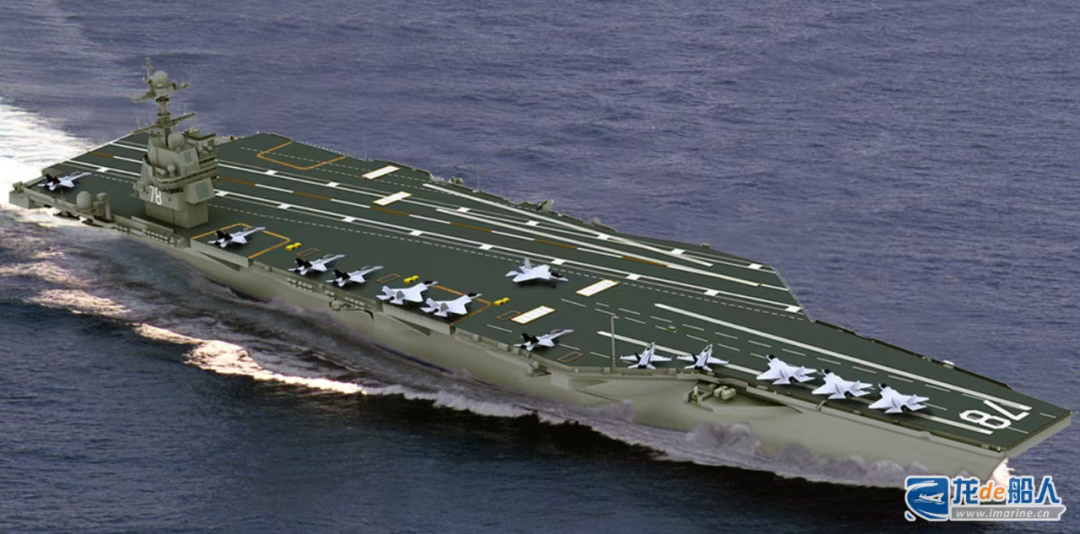
Recently, HII announced that it has been awarded a series of contracts worth approximately $142 million for the construction and upgrade of the second Ford-class aircraft carrier of the U.S. Navy, the USS John F. Kennedy (CVN-79).
It is worth noting that the USS John F. Kennedy is under construction at Newport News Shipbuilding, a subsidiary of HII, which indicates that the upgrade program has been initiated before the ship is even completed. This means that the second Ford-class aircraft carrier of the US Navy is facing the predicament of being “obsolete from the moment it is born”!
The U.S. Department of Defense stated that the upgrade project aims to ensure that the USS John F. Kennedy aircraft carrier “is delivered with enhanced combat capabilities” while processing “unpriced change orders,” and is expected to be completed by June 2026.
It is noteworthy that the U.S. Department of Defense did not immediately allocate funds for the upgrade project of the aircraft carrier under construction. In other words, the shipyard needs to carry out this large-scale upgrade project without receiving advance payment.
Starting construction based solely on an “IOU” is unprecedented for shipyards. Furthermore, the series of contracts HII has secured indicates that the U.S. Navy acknowledges that engineering work related to the launch of an aircraft carrier and the completion of all construction work has become an increasingly difficult problem for the U.S. Navy.
It is virtually unprecedented for any shipyard to commence construction solely based on an “IOU”. Meanwhile, the series of contracts recently secured by HII also essentially indicates that the U.S. Navy has acknowledged that the related engineering work on aircraft carriers after their launch but prior to the completion of all construction has become an increasingly intractable challenge for the service.
Even more challenging is the fact that the U.S. Ford-class aircraft carriers have long faced issues such as system improvements and combat capability enhancements before delivery. The first vessel, the USS Gerald R. Ford, not only experienced delayed delivery and severe budget overruns, but also required continuous upgrades after delivery.
Clearly, the Ford-class aircraft carriers have reaped the consequences of their overly complex design—the ailing U.S. naval shipyards simply cannot meet the ever-increasing demands of these extremely complex and massive shipboard systems. In other words, this is a true reflection of the decline of U.S. shipyards.
However, while the Ford-class aircraft carrier is “a disaster for the U.S. Navy,” this series of contracts, worth over $140 million, is a windfall for shipbuilders, provided that Newport News Shipbuilding can deliver on time.
For the U.S. Navy and the U.S. Coast Guard, delays in defense shipbuilding projects are no longer surprising.
On November 25, the U.S. Navy announced the termination of its order for four Constellation-class frigates from the Italian shipbuilding group Fincantieri. While both parties cited “the U.S. Navy’s own needs” as the reason, it’s clear that the project is facing significant schedule challenges. The first Constellation-class frigate, originally scheduled for delivery in April 2026, is now expected to be delivered in April 2029, a delay of 36 months.
Earlier, the U.S. Department of Homeland Security announced the cancellation of the 11th Legend-class patrol vessel to be built by Ingalls Shipbuilding; it also announced the cancellation of the order for the 3rd and 4th offshore patrol vessels from the Eastern Shipbuilding Group, which has also suspended the construction of the 1st and 2nd offshore patrol vessels.
According to information released by the U.S. Government Accountability Office (GAO), these projects all share a core flaw: construction commenced before design was finalized.