


Liquefied natural gas (LNG) carriers have long been a source of pride for the South Korean shipbuilding industry as a high-value-added vessel type, but market share in this sector is now gradually shifting to Chinese shipbuilders.
Clarksea data shows that in October 2026, global shipowners placed orders for a total of seven large LNG carriers. Chinese and South Korean shipbuilders secured orders for five and two vessels, respectively; this marked the first time Chinese shipbuilders surpassed South Korean shipbuilders in monthly orders. During that month, the market shares of Chinese and South Korean shipbuilders were 71.4% and 28.6%, respectively.
Last month, Malaysia International Shipping Corporation (MISC) placed an order with Hudong-Zhonghua for five 174,000 m³ LNG carriers; the contract value was not disclosed, and delivery is expected to begin in 2030. So far in 2026, MISC has placed orders with Hudong-Zhonghua for 11+5 LNG carriers, including 10+5 174,000 m³ LNG carriers and 1 18,700 m³ small LNG carrier.
Two LNG carriers for a Japanese shipowner—Kawasaki Kisen Kaisha (K Line)—are being built by South Korea’s Samsung Heavy Industries. Each vessel costs approximately $250 million, and they are scheduled to be delivered successively by May 2029.
In terms of backlog orders, from January to October 2026, global shipowners placed orders for a total of 76 large LNG carriers, representing a year-over-year increase of approximately 3.5 times compared to the 17 vessels ordered during the same period last year. During this period, Chinese and South Korean shipbuilders secured orders for 32 and 44 vessels, respectively, accounting for market shares of 42.1% and 57.9%.
For comparison, data from Clarkson shows that a total of 37 large LNG carriers were ordered throughout 2025, with Chinese shipbuilders securing only 3 of these—a market share of approximately 8%. This implies that, in less than a year, Chinese shipbuilders have increased their share of annual orders in the LNG carrier market to around 42%.
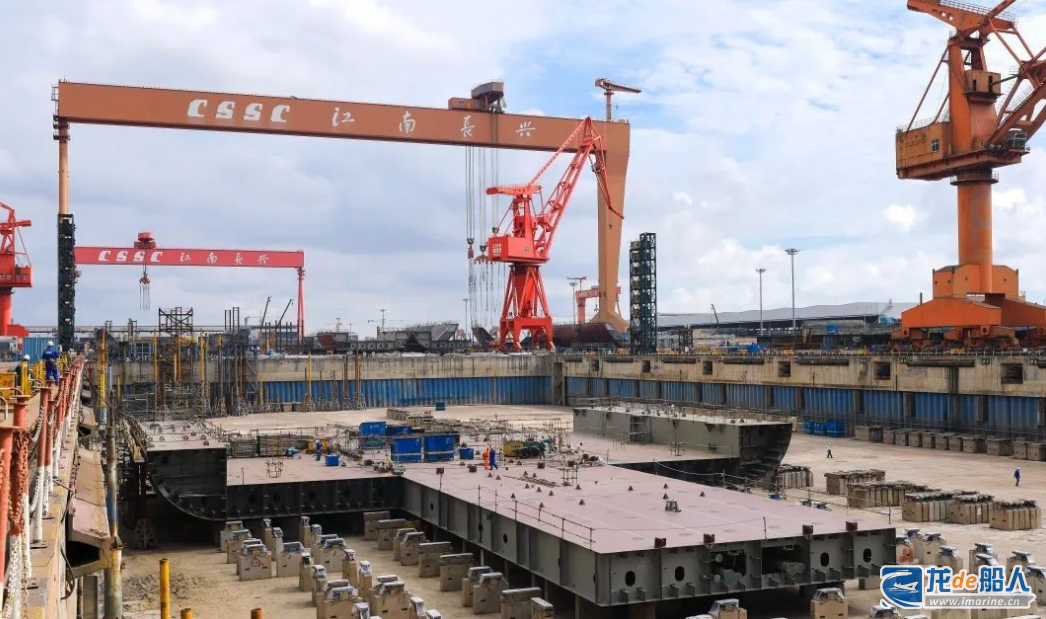
Since 2026, orders for LNG carriers received by Chinese shipbuilders have been primarily secured by Hudong-Zhonghua and Jiangnan Shipyard, both subsidiaries of China State Shipbuilding Corporation (CSSC), with Hudong-Zhonghua receiving slightly more orders than Jiangnan Shipyard.
Some analysts believe that over the past 10 months, production capacity and pricing have been the two main drivers behind Chinese shipbuilders’ rapid order intake: by offering quotes below market benchmark prices—combined with relatively ample construction capacity—Chinese shipbuilders can provide shipowners with earlier delivery dates, prompting some shipowners to shift their orders to China. In August of this year, Hudong-Zhonghua and Jiangnan Shipyard successively launched capacity expansion projects. Hudong-Zhonghua’s project is positioned as a world-leading large-scale ship assembly base, focusing on enhancing the mass production and intelligent construction capabilities for high-end vessel types such as large LNG carriers and ultra-large container ships.
Currently, the number of shipyards in China with the capability to build LNG carriers and that have already delivered completed vessels has increased to five: Hudong-Zhonghua, Jiangnan Shipyard, Dalian Shipbuilding, China Merchants Heavy Industries Haimen Shipyard (CMHI Haimen Shipyard), and Yangzijiang Shipbuilding.
Market sources also indicate that Hengli Heavy Industries, China’s emerging private shipbuilding giant, plans to build two LNG carriers on its own. If the company enters this market segment, leveraging its scale and production capacity advantages, competition for orders between Chinese and South Korean shipbuilders in this sector is expected to intensify, and South Korean shipbuilders’ market share may be further squeezed.
South Korean media have noted that the pace at which Chinese shipbuilders are securing orders in the LNG carrier market this year has raised alarms within the South Korean shipbuilding industry. According to reports, during a recent earnings conference call, HD Korea Shipbuilding & Offshore Engineering (HD KSOE) explicitly identified Hudong-Zhonghua Shipbuilding and Jiangnan Shipyard as competitors in the LNG carrier market. The company further analyzed that price advantages—combined with projects linked to Chinese cargo owners—are the primary drivers behind the steady accumulation of LNG carrier orders by Hudong-Zhonghua and Jiangnan Shipyard.
An official from the Overseas Economic Research Institute at the Export-Import Bank of Korea stated: “Technical reliability is paramount for LNG carriers, and the overall market position of South Korean shipbuilders is unlikely to be easily overtaken; however, the growing market share of Chinese shipbuilders is an undeniable reality. In response, South Korean shipbuilders should diversify their order portfolios—currently overly concentrated on LNG carriers—leverage overseas shipyards, and begin preparing for the future market.”
Another source from the South Korean shipbuilding industry remarked: “It is a natural trend for China to increase its market share in the LNG carrier sector; South Korea should strive to maintain its competitive edge for as long as possible through technological development.”