


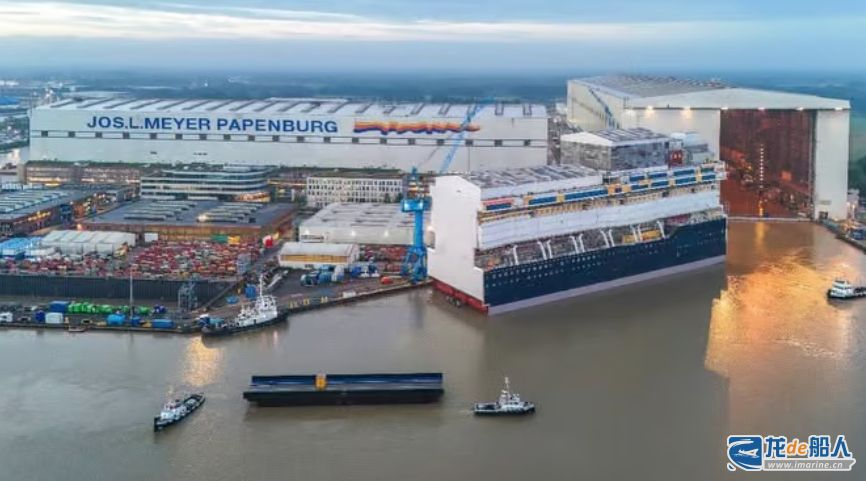
MSC, the world’s largest shipowner, is in talks with the German federal government and the government of Lower Saxony regarding the acquisition of an equity stake in Meyer Werft, a German shipyard renowned for building luxury cruise ships. Two years ago, Meyer Werft became a state-controlled enterprise; the federal government and the state of Lower Saxony jointly hold approximately 80% of the shares, while the Meyer family retains the remaining 20%.
World’s largest shipowner signals renewed interest in acquiring a shipyard.
According to Bloomberg, MSC plans to acquire the approximately 80% stake in Meyer Werft held by the German federal government and the state government of Lower Saxony. In 2024, the federal and state governments jointly invested €400 million to acquire this 80% stake and provided €2.6 billion in loan guarantees to help the financially distressed shipyard secure refinancing, aiming to ensure its continued operation through at least 2028 and the delivery of existing cruise ship orders.
Following the restructuring, the Meyer family retains a 20% stake in Meyer Werft and holds a right of first refusal to repurchase the government’s shares before 2028, though the family no longer holds management control over the shipyard.
Reports indicate that the German federal government and the government of Lower Saxony are demanding the recovery of at least the full amount of the equity investment made in Meyer Werft two years ago, implying a minimum price of €400 million for MSC’s acquisition of the stake. Furthermore, given the critical role Meyer Werft’s two major shipbuilding sites in Papenburg and Rostock play in securing local employment, the German government is highly likely to require the buyer to provide guarantees regarding jobs and continued operations.
Given its previous experience with Genting Hong Kong, the German government is taking a cautious stance on MSC’s proposed transaction. Genting Hong Kong had previously acquired three shipyards to form MV Werften. Unfortunately, that transaction ultimately led to the bankruptcy of the shipyards involved.
Reportedly, this is not the first time MSC has been linked to plans to acquire a shipyard. Market rumors previously circulated that MSC intended to partner with the European defense giant Rheinmetall to acquire the Mangalia shipyard in Romania, with plans to utilize the facility for the construction and repair of cruise ships and other commercial vessels.
However, MSC does not appear to have made a move during the bidding process for the Mangalia shipyard, as the facility currently remains without any takers.
Mystery Surrounds Mega Order—Could a Major Client Be the New Owner?
MSC is no stranger to Meyer Werft and is poised to become a key client. In December 2025, MSC Cruises—a subsidiary of MSC—announced the signing of a letter of intent with Meyer Werft for the construction of four “New Frontier” class cruise ships, with an option for two additional vessels.
The New Frontier class represents a brand-new ship design for MSC Cruises, featuring a gross tonnage of approximately 180,000 and a maximum passenger capacity of 5,400. The six ships covered by the agreement with Meyer Werft constitute the first vessels of this class; deliveries are scheduled to begin in 2030, with one ship handed over annually through at least 2035.
German officials revealed at the time that the order was valued at a minimum of €10 billion, stating that the formal contract would be signed within the next six months, thereby securing Meyer Werft’s shipbuilding capacity for the coming decade.
In late June 2026, MSC Cruises and Meyer Werft issued a joint statement revealing the project’s progress: “Detailed design planning and negotiations for the formal shipbuilding contract have reached the final stages; both parties are confident that negotiations will conclude successfully within the coming weeks, at which point a public announcement will be made.”
In July 2026, Bloomberg reported that the German federal government had approved state loan guarantees worth €11.5 billion for the cruise ship project.
Despite these positive signals, and although nine months have passed since MSC Cruises and Meyer Werft signed the letter of intent—and three months since the progress update—there has still been no news regarding the finalization of this major cruise ship order.
With orders booked through 2030, Meyer Werft Is Still Operating at a Loss.
Aside from the large cruise ship orders that remain unresolved, Meyer Werft’s financial situation remains a cause for concern following its transition to a German state-controlled enterprise, and the company continues to operate at a loss.
In 2025, although Meyer Werft is set to generate strong revenue—driven by the delivery of the ocean-going cruise ships “Asuka III” and “Disney Destiny” and two river cruise ships, alongside the completion of the “Disney Adventure” and construction work on a German research ship and an offshore energy conversion platform—it remains in the red, with projected losses of approximately €384 million.
Meyer Werft attributed the annual loss to financial losses resulting from legacy contracts, as well as financial pressure stemming from the shipyard having to self-finance construction without receiving progress payments.
Meyer Werft management stated: “Due to declining supply and labor costs, the company expects to narrow its losses and approach a break-even point in 2026. Although no cruise ship deliveries are scheduled for this year, financial restructuring is proceeding according to plan.”
Meyer Werft is part of the German Meyer Group and is renowned for cruise ship construction; its history dates back to 1795. The company began developing its cruise ship building business in the 1980s and delivered the world’s first cruise ship equipped with a low-emission liquefied natural gas (LNG) propulsion system in 2018; to date, it has built and delivered nearly 60 luxury cruise ships.
Currently, Meyer Werft’s projects under construction include two 180,000 GT cruise ships for Carnival Cruise Line—the “Carnival Festivale” and “Carnival Tropicale”—as well as the 140,000 GT “Disney Believe” and three smaller cruise ships for Disney Cruise Line. Additionally, the company is building river cruise ships for Viking Cruises, with delivery schedules extending to 2030.