


South Korean media reports indicate that some in the country’s shipbuilding industry believe Samsung Heavy Industries may lag behind other shipbuilders in terms of competitiveness for orders in the market for next-generation fuel-powered vessels, such as those powered by ammonia and hydrogen. This concern stems from the fact that Samsung Heavy Industries has not yet established a business division or subsidiary dedicated to engines—often referred to as the “heart of a ship.” Industry observers in South Korea believe that once demand for next-generation fuel-powered vessels surges, this shortcoming will become a major obstacle to the shipbuilding giant’s growth.
A particular concern for the South Korean shipbuilding industry is that, as other competing shipyards are increasingly installing ammonia-powered engines in mainstream commercial vessels such as container ships and liquefied natural gas (LNG) carriers to comply with International Maritime Organization (IMO) environmental regulations, Samsung Heavy Industries may lack the competitiveness to keep pace.
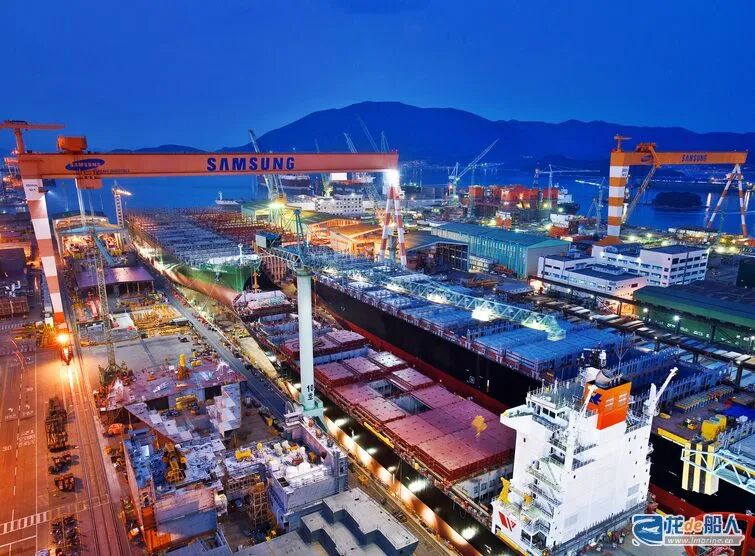
Currently, Samsung Heavy Industries is the only leading shipbuilder among South Korea’s top three shipbuilders that has not established its own engine-related business division or subsidiary. Samsung Heavy Industries originally had an in-house engine division prior to 1999, but during the industrial restructuring that followed the International Monetary Fund (IMF) foreign exchange crisis, that division was merged with the relevant business units of Korea Heavy Industries and Daewoo Heavy Industries to form a joint venture called Korea Marine Machinery (now Hanwha Engine). Since then, Samsung Heavy Industries has completely withdrawn from the engine manufacturing business.
Subsequently, South Korea’s marine machinery industry went through various phases, including Doosan Engine and HSD Engine, and grew to become the world’s second-largest manufacturer of marine low-speed engines at the time. In 2024, it was acquired by Hanwha Group and renamed Hanwha Engine.
Since 1999, whenever Samsung Heavy Industries has secured new shipbuilding orders, all related marine engine equipment has been sourced from external companies such as the engine manufacturing division of HD Hyundai Heavy Industries and Hanwha Engine. In recent years, as the shipbuilding industry has entered a new growth cycle and shipbuilders’ financial performance has gradually improved, the procurement costs for marine raw materials and components have risen accordingly.
In 2025, Samsung Heavy Industries’ total costs for raw materials—such as marine steel plates, engines, and structural steel—reached 4.856 trillion KRW, a 39.7% increase from 2023 (3.475 trillion KRW); this figure aligns to some extent with the market consensus forecast of 14.5006 trillion KRW in revenue for 2027 (a 36.2% increase over 2025).
However, the issue lies in the fact that Samsung Heavy Industries is currently focusing on securing orders for new vessels within the liquefied natural gas (LNG) value chain—such as LNG carriers—even though LNG is merely a “bridge fuel” for maritime decarbonization and is destined to be replaced by cleaner, more efficient fuels in the future. In contrast, other major global shipyards are going all out to develop zero-carbon vessels in alignment with the IMO’s carbon-neutrality roadmap; ammonia-fueled ships are the prime example of this effort, with technology development nearing the commercialization stage and commercial gas carriers equipped with ammonia dual-fuel engines already built and delivered.
Consequently, there is speculation within the South Korean shipbuilding industry that Samsung Heavy Industries may see its competitiveness in securing orders for next-generation fuel-powered vessels decline. This view stems from the fact that the liquefaction temperature of ammonia is -33.4°C—far higher than the -162°C required for LNG; as a result, the industry generally considers engine, safety, and fire-suppression systems—rather than cargo tank technology—to be the decisive factors in order competitiveness. The ability to manufacture standardized engines directly impacts a shipyard’s profitability, placing Samsung Heavy Industries—which lacks in-house engine production capabilities—at a disadvantageous operational position from the outset.
Furthermore, risks stemming from shipowners placing bulk orders and the uncertainty surrounding delivery schedules are also a cause for concern. In standard shipbuilding contracts, shipowner requirements carry decisive weight, and it is common practice for shipyards to provide “bundled” quotes covering both the hull and the engine. This implies that in the future market for vessels powered by next-generation fuels, shipyards capable of manufacturing their own engines will gain a competitive edge through superior pricing and faster delivery times.
At the same time, the capacity for technological iteration and expansion in next-generation fuel engines is crucial. Currently, HD Hyundai Heavy Industries plans to install ammonia dual-fuel engines on mainstream commercial vessels through three in-house engine subsidiaries of HD Hyundai Group; meanwhile, Hanwha Ocean is collaborating with Hanwha Power Systems and Baker Hughes to develop ammonia gas turbines suitable for LNG carriers and container ships.
Samsung Heavy Industries also began relevant technical R&D as early as 2019 in collaboration with classification societies and engine manufacturers; however, as its primary focus was on engine auxiliary equipment and hull design, it is unlikely to secure a leading position in core engine technology. This explains why, while Samsung Heavy Industries kept pace with HD Hyundai Heavy Industries and Hanwha Ocean during the conceptual design certification phase for ammonia-powered vessels, it has gradually fallen behind in the subsequent stages of onshore engine testing (Phase 2) and sea trials (Phase 3).
In this regard, an official from the South Korean shipbuilding industry analyzed the situation as follows: “In the market for next-generation fuel-powered vessels, possessing engine capabilities will directly impact competitiveness in securing orders… Only by mastering core engine technologies can a company gain an advantage in terms of profitability and delivery schedules.”