


On March 30, Zhoushan Changhong International Shipyard held the keel-laying ceremony for the CHB2059, the first 11,400-TEU LNG dual-fuel container ship being built for OCEANROUTES. This marks the official launch of the project collaboration between ZHC International and the new shipowner, as both parties enter a new phase of mass production of large dual-fuel container ships.
OCEANROUTES is an affiliate of the TMS Group, which is owned by Greek shipping magnate George Economou.
In February 2025, ZHC International announced that it had secured an order for 10 11,400-TEU LNG-powered dual-fuel container ships from TMS Group. In December, TMS Group placed an additional order for 8+2 vessels of the same type. At the time, industry sources reported that the construction cost per vessel was approximately $140 million.
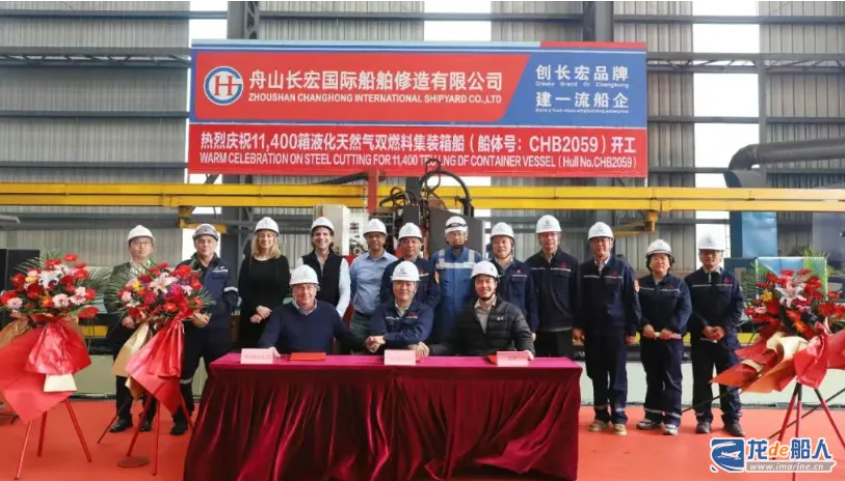
The project comprises a total of 18 vessels, marking another major order for ZHC International in the field of high-end green shipbuilding and further strengthening the company’s strategic partnerships with leading international shipowners and classification societies.
This series of vessels was jointly developed and designed by China International Marine Containers Offshore Research Institute (CIMC ORIC) and ZHC International. As a new generation of large container ships, it has overcome numerous core technical challenges in terms of economic efficiency, lightweight construction, system integration, and shipbuilding processes, serving as an important benchmark. The design incorporates key technologies such as a wide-body optimized layout, the use of lightweight materials, and the integration of dual-fuel systems. It is currently the largest order for a single 10,000-TEU vessel type.
The vessel has an overall length of approximately 299.95 meters, a beam of 48.20 meters, and a draft of 27.0 meters, and is classified by DNV. Through the application of various energy-saving technologies—including wind deflectors, energy-saving ducts, and high-efficiency twisted rudders—the vessel effectively reduces main engine fuel consumption. While meeting the requirements of the latest regulations, it achieves an energy efficiency level that is over 30% below the EEDI Phase 3 standard.