


On January 10, SPDM 3.0 – China’s next-generation ship product data lifecycle management platform independently developed by Shanghai Dongxin Software Engineering, a subsidiary of Hudong-Zhonghua Shipbuilding under China State Shipbuilding Corporation (CSSC) – was officially unveiled in Shanghai. This groundbreaking solution seamlessly integrates the entire design and manufacturing management workflow, set to spearhead the development of a new digital transformation ecosystem for China’s shipbuilding industry.
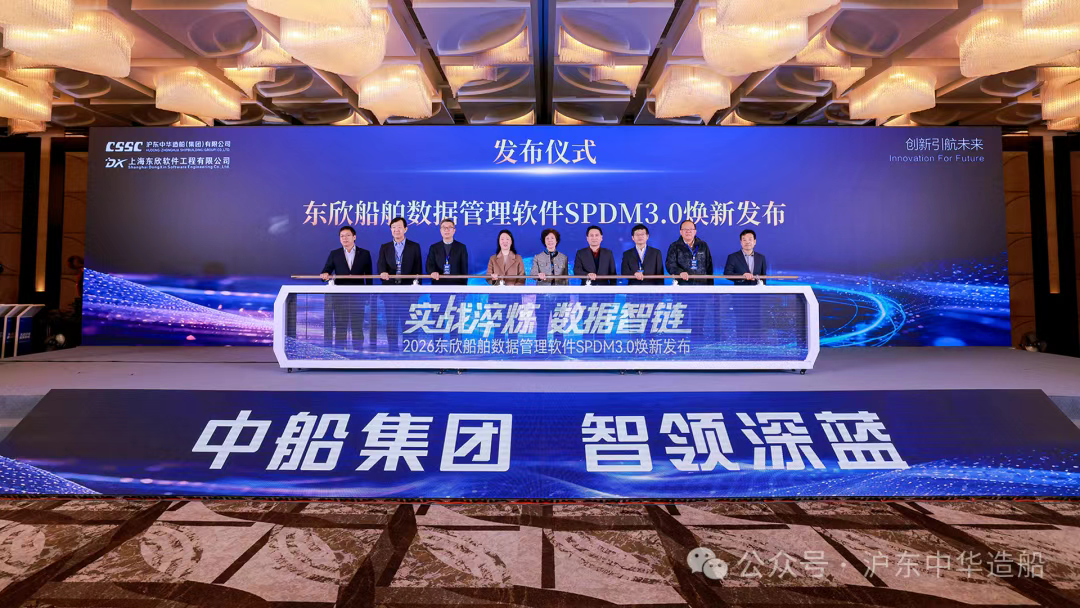
Shanghai Dongxin Software Engineering is one of the earliest software companies in China to dedicate itself to the independent research and development of ship product data management platforms. The company began its independent research and development in 2010, launching SPDM 1.0 in 2014 and SPDM 2.0 in 2024. Notably, with the official release of SPDM 3.0, the pace of innovative iteration has accelerated, refining platform functionality to perfection. This has cultivated core capabilities uniquely characterized by Chinese features, shipbuilding characteristics, and contemporary traits.
The SPDM 3.0 system covers the core business chain of ship design and establishes an integrated data management system. On the one hand, it realizes the full lifecycle management of design documents and data, enabling end-to-end digital and intelligent control from drawing creation, version iteration to filing and traceability. On the other hand, through design plan management, man-hour management and process control, it accurately decomposes design tasks, calculates man-hour costs and standardizes approval processes, helping enterprises achieve lean management and control of design work.
Addressing the core need for cross-departmental and cross-disciplinary collaboration in ship design, the system breaks down data silos to enable seamless data flow across multiple disciplines including hull, machinery, and electrical systems. Its built-in knowledge management module consolidates valuable digital assets such as ship design standards and typical case studies, empowering newcomers to quickly get up to speed and elevating the overall capabilities of the design team.
Furthermore, SPDM 3.0 provides a range of fundamental business integration tools and services to help enterprises build an interconnected ecosystem. In terms of performance assurance, it offers distributed caching, high-performance RPC (Remote Procedure Call) communication, incremental data submission, transmission compression, parallel computing, asynchronous processing, and performance monitoring technologies, providing flexible, highly available, and high-performance operational support for enterprise business applications.
Meanwhile, SPDM3.0 focuses on security and autonomy, implementing security protection and hardening measures in multiple aspects such as access control, data transmission, and data storage to achieve comprehensive protection and compliance with confidentiality requirements. At the system application level, it achieves independent and controllable security, supporting basic software and hardware environments such as domestic CPUs (Central Processing Units), operating systems, databases, and middleware. It can be smoothly migrated to domestic platforms with little or no additional development, realizing independent control and seamless migration. The system is committed to building a digital, networked, intelligent, standardized, and scalable data management platform, forming an independently developed marine industrial software that can replace imported alternatives.
Currently, the wave of digital transformation is profoundly reshaping the global industrial landscape. The newly released SPDM3.0, China’s next-generation ship product data lifecycle management platform, precisely addresses pain points in the shipbuilding industry such as the difficulty of managing massive amounts of data, frequent design changes, and complex collaboration. This platform establishes a comprehensive solution spanning design, manufacturing and management.