


On March 3, Norwegian car transport company United European Car Carriers (UECC) announced on its official website that it had placed an order with China Merchants Jinling Shipyard Nanjing for two 3000 CEU multi-fuel + battery hybrid Pure Car and Truck Carriers (PCTCs), with delivery expected in early 2028. The shipbuilding contract was officially signed on March 2.
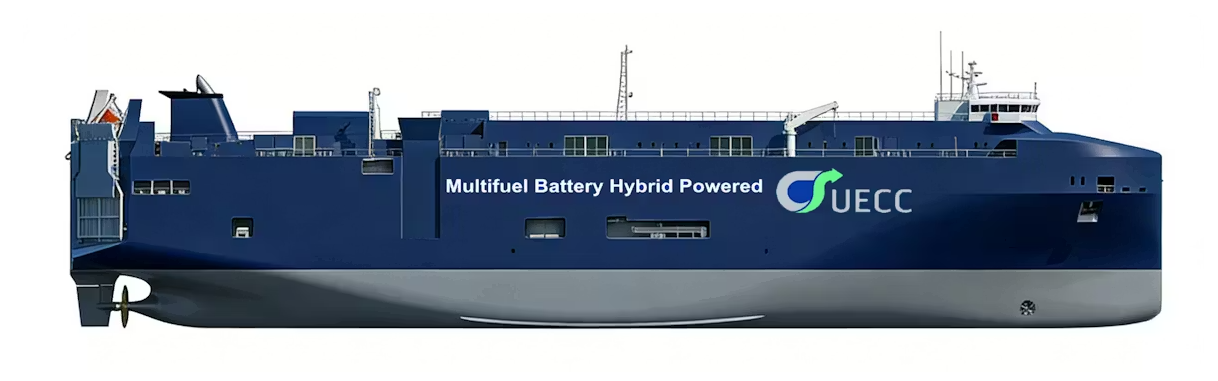
Including two 4,500 CEU battery-hybrid PCTCs ordered in 2024, China Merchants Jinling Shipyard Nanjing has received orders for four new vessels from UECC. UECC stated that the latest shipbuilding contract with China Merchants Jinling Shipyard Nanjing aims to enhance the company’s carrying capacity and flexibility in European short sea trade while further expanding its fleet of environmentally friendly PCTCs.
The latest newbuildings, developed in close cooperation with Shanghai Ship Research & Design Institute (SDARI), measures 169.5 meters in length, features nine decks, and is equipped with a 160-ton stern ramp, enabling flexible transport of various vehicles, heavy construction machinery, and other ro-ro cargoes. These vessels will serve UECC’s European short sea shipping network. With industry-leading deck height and enhanced deck strength, the new vessel can transport oversized cargo and project cargo far exceeding the capacity of traditional PCTCs, thereby opening up cargo markets previously inaccessible to conventional shipping.
This PCTC employs a near-ballast-free design to achieve exceptionally low fuel consumption. It is equipped with a real-time emissions monitoring system, enhancing transparency and continuous visibility of environmental performance. Featuring a multi-fuel liquefied natural gas (LNG) main engine and advanced propulsion system, the vessel utilizes a streamlined hull design to reduce fuel consumption while also possessing shore power connectivity capabilities.
UECC emphasizes that this PCTC design offers flexible scalability, enabling adaptation to future technological innovations and new alternative fuels.
Moreover, safety is the primary focus in the development of this PCTC. The hull incorporates reinforced safety structures designed to enhance fire resistance, integrating more sophisticated monitoring, detection, and emergency response systems to ensure the secure transport of high-demand cargo, including hazardous materials. Its design not only meets current regulatory requirements but also addresses evolving fire risk characteristics and aligns with future safety standards.
Moreover, the two latest hybrid-powered UECC vessels contracted by China Merchants Jinling Shipyard Nanjing will be equipped with an integrated digital architecture designed to enhance operational insights and decision-making efficiency. Glenn Edvardsen explained: “Advanced monitoring and data processing capabilities will optimize performance management, situational awareness, and lifecycle management, collectively ensuring safer, more efficient, and transparent operations throughout the vessels’ service life.”
“These newbuildings represent a significant step forward in safety, efficiency and environmental performance, while redefining cargo-carrying capability in the PCTC segment,” UECC’s CEO Glenn Edvardsen said after signing the newbuilding contract on 2 March.
Data indicates that UECC is a leading provider in sustainable offshore ro-ro transport in Europe, currently operating a fleet of PCTCs dedicated to delivering sustainable logistics solutions. The company currently holds orders for four new vessels, all under construction by China Merchants Jinling Shipyard. Combined with vessels delivered since 2016, it now operates a fleet of nine LNG dual-fuel/multi-fuel + battery hybrid PCTCs. This series of vessels is capable of utilizing liquefied biomethane (LBM) as fuel.