


Amid a booming market for Pure Car and Truck Carriers (PCTC), new vessel orders have emerged once again: Global Car Carriers (GCC)—a PCTC owner backed by the world’s largest shipping line, Mediterranean Shipping Company (MSC)—has further expanded its orderbook with Chinese shipyards.
The fleet list on the official website of Global Car Carriers shows that the shipowner has ordered two additional 8,600 CEU liquefied natural gas (LNG) dual-fuel PCTCs from Zhoushan Changhong International Shipbuilding Co., Ltd. (Zhoushan Changhong International), listed as Viking NB 23 and Viking NB 24, and are expected to be delivered in 2030.
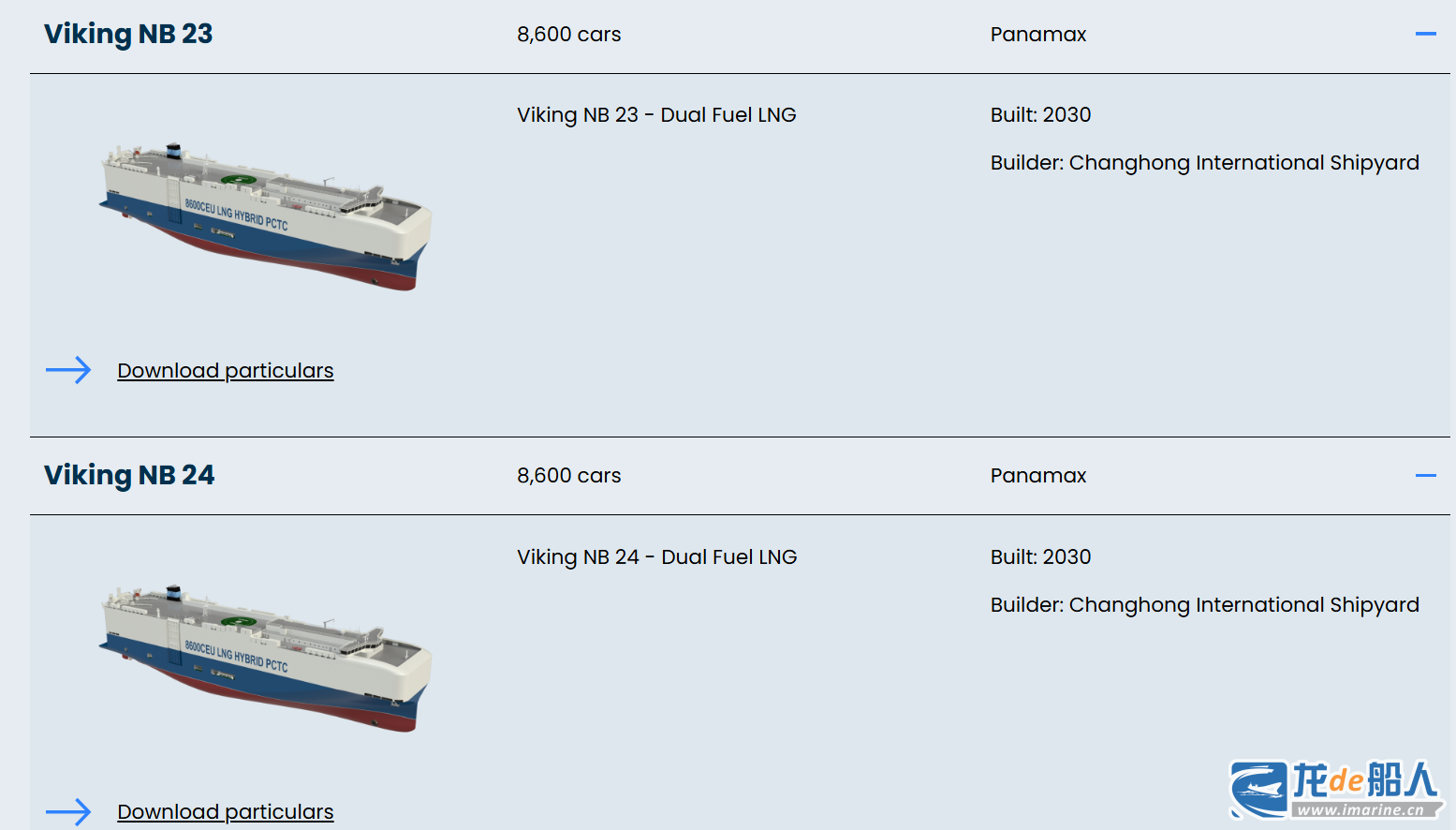
Zhoushan Changhong International, which previously focused primarily on the construction of container ships, bulk carriers, oil tankers, and chemical tankers, has entered the high-value-added PCTC market by securing an initial order for two 8,600-CEU vessels from Global Car Carriers (designated as Viking NB 21 and Viking NB 22). With the addition of two more vessels to the order, the total number of ships under this partnership has reached four, with all deliveries scheduled for 2030.
Although the partnership between Global Car Carriers and Zhoushan Changhong International began in 2026, its parent company, MSC, is a long-standing client of this private shipbuilder. In recent years, MSC has placed orders for nearly 50 container ships (including options) with Zhoushan Changhong International, ranging in capacity from 10,300 TEU to 21,700 TEU. Deliveries are scheduled through 2029, with several vessels having already been delivered.
In addition, Global Car Carriers has placed an additional order for two 8,600-CEU LNG dual-fuel PCTCs at China Merchants Heavy Industry Weihai Shipyard—designated as Viking NB 25 and Viking NB 26—with delivery expected in 2031.
Twenty-six new vessels have been ordered from five Chinese shipyards. The breakdown is as follows: China Merchants Heavy Industry (Weihai) Shipyard will build eight 8,600-CEU (car equivalent unit) vessels and two 7,000-CEU vessels, with delivery scheduled between 2028 and 2031; China Merchants Jinling Shipyard will construct six 8,600-CEU vessels, slated for delivery between 2028 and 2029; Guangzhou Shipyard International (GSI) will build two 8,600-CEU vessels and two 7,000-CEU vessels, with delivery planned for 2028–2029; Mawei Shipbuilding will construct two 8,600-CEU vessels, due for delivery in 2030; and Zhoushan Changhong International will build four 8,600-CEU vessels, also scheduled for delivery in 2030.
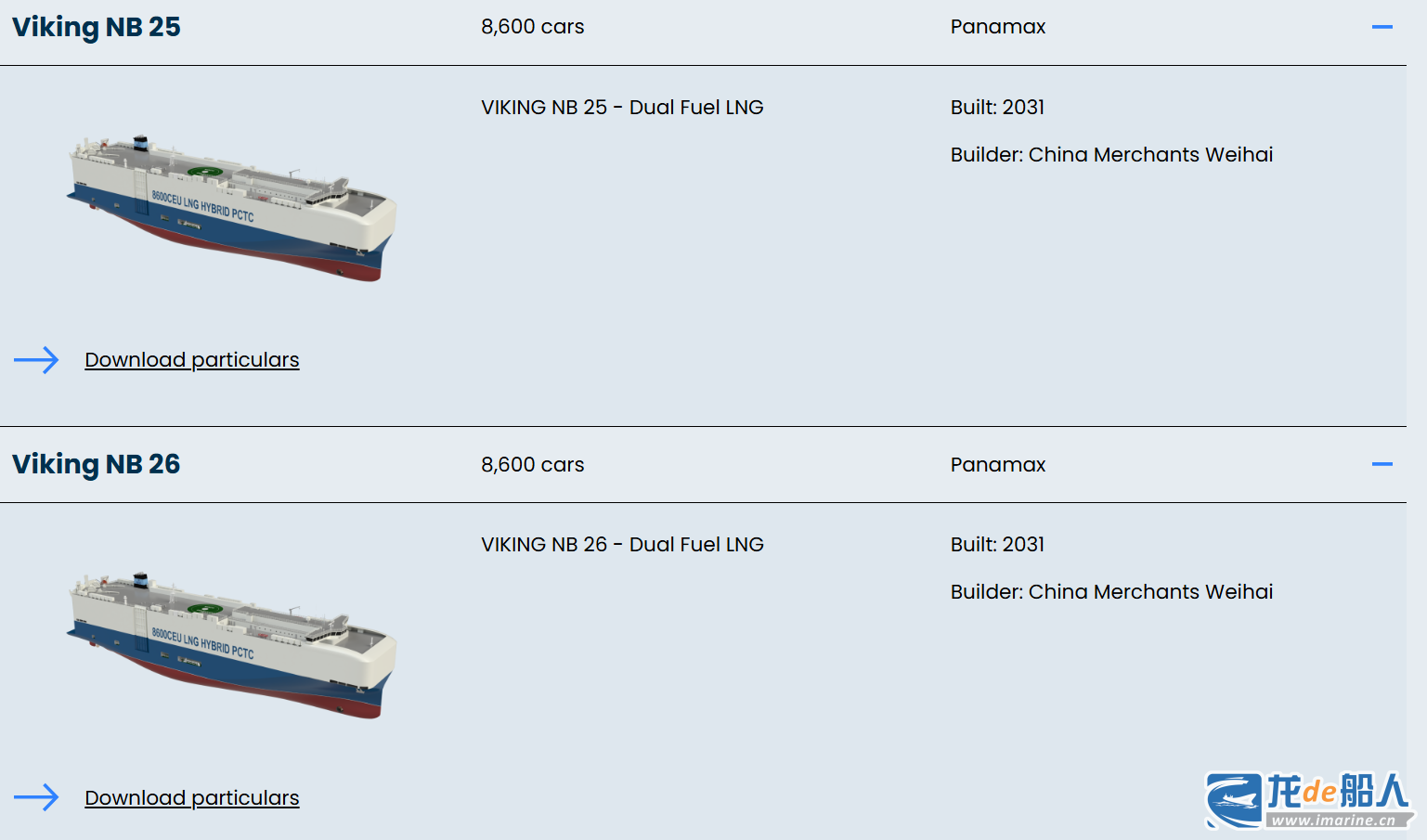
To date, Global Car Carriers holds orders for 10 PCTCs at China Merchants Heavy Industry Weihai Shipyard. This includes two 7,000-CEU vessels scheduled for delivery in 2028 and 2029, as well as eight 8,600-CEU vessels scheduled for delivery between 2029 and 2031.
In 2024, MSC acquired Gram Car Carriers for $700 million. In 2026, the company was renamed Global Car Carriers—retaining the same abbreviation, “GCC.” Following its acquisition by MSC, Global Car Carriers plans to expand its fleet from an initial count of over 20 vessels to more than 60, a move that has triggered a new round of shipbuilding initiatives.
According to data from the company’s official website, Gram Car Carriers currently has 26 new PCTC vessels under construction, including 22 8,600 CEU vessels and 4 7,000 CEU vessels, all equipped with LNG dual-fuel propulsion systems. These vessels are scheduled for delivery in 2028 (4 vessels), 2029 (9 vessels), 2030 (11 vessels), and 2031 (2 vessels), respectively.
Twenty-six new vessels have been ordered from five Chinese shipyards. Specifically, China Merchants Heavy Industry Weihai Shipyard will build eight 8,600-CEU vessels and two 7,000-CEU vessels, with delivery scheduled between 2028 and 2031. China Merchants Jinling Shipyard (Jiangsu) will construct six 8,600-CEU vessels, scheduled for delivery between 2028 and 2029. Guangzhou Shipyard International (GSI) is set to build two 8,600-CEU vessels and two 7,000-CEU vessels, with delivery planned for 2028–2029. Mawei Shipbuilding will construct two 8,600-CEU vessels, due for delivery in 2030, while Zhoushan Changhong International will build four 8,600-CEU vessels, also scheduled for delivery in 2030.
It is understood that both of Gram Car Carriers’ ship types currently under construction were designed by the Shanghai Ship Research and Design Institute (SDARI).
The 8600-CEU vessels is SDARI’s second-generation LNG/battery hybrid PCTC. Measuring 199.95 meters in length and 38 meters in breadth, the vessel is equipped with an MAN B&W 6S60ME-C10.7-GI-EcoEGR dual-fuel main engine and a 500 kWh energy storage battery system. It includes provisions for future conversion to ammonia fuel and complies with both IMO Tier III NOx emission standards and EEDI Phase 3 energy efficiency requirements. Furthermore, the vessel features an 11 kV high-voltage shore power system, enabling zero-emission operations while in port. The design has also been specifically optimized for the transport of electric and hydrogen-powered vehicles, with enhanced safety protocols and improved loading efficiency.
The 7000-CEU vessels is an energy-efficient, LNG dual-fuel, deep-sea vessel developed and designed by SDARI. It measures 199.9 meters in length and 38 meters in breadth. The vessel is powered by an MAN B&W 6S60ME-C10.5-GI-EcoEGR dual-fuel main engine, which complies with IMO Tier III NOx emission standards in both liquid-fuel and gas-fuel modes. It features an S-type bulbous bow for enhanced energy efficiency and is equipped with a shore-power connection to achieve zero emissions while in port. The design incorporates four heavy-duty decks and four hoistable decks, allowing for the flexible loading of both heavy vehicles and standard passenger cars.
As the world’s third-largest owner of car carriers, Gram Car Carriers operates a fleet of 48 PCTCs, including newly built vessels. The 22 active PCTCs in its fleet have individual capacities ranging from 2,000 to 7,000 vehicles.