


COSCO Shipping Heavy Industry (Dalian) officially delivered and named the “Guo Yi Hai” on July 3, the fifth 80,000 DWT multi-purpose grain carrier it has built for COSCO Shipping Development.
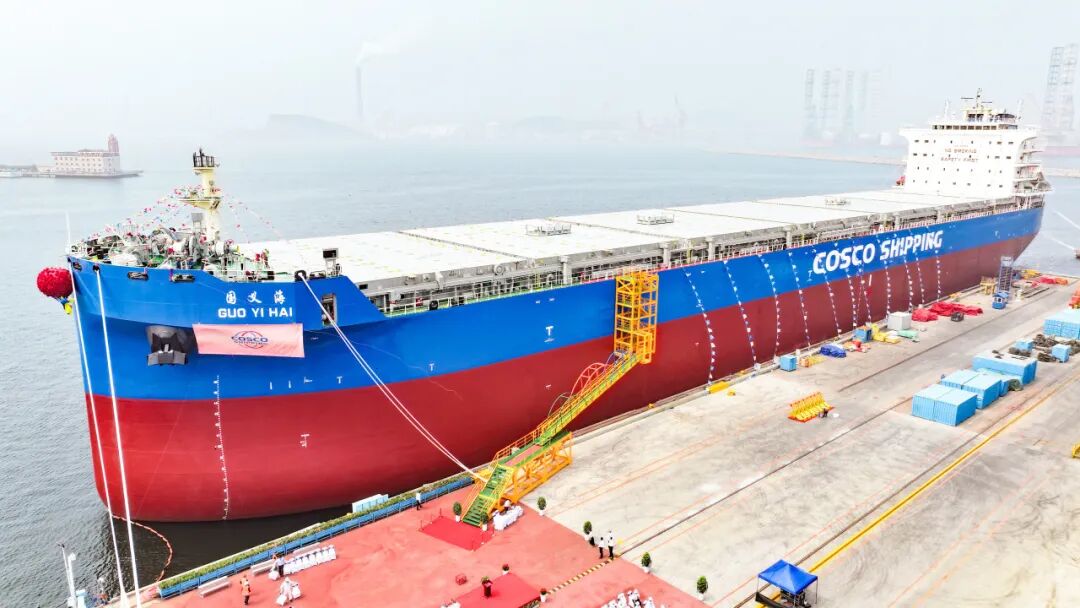
This series of vessels, independently developed and designed in China, represents the world’s first multi-purpose vessel specifically designed for grain transport. With a total length of 229.95 meters and a beam of 32.26 meters, the vessels feature ample cargo hold space and are capable of transporting various types of grain—including soybeans, corn, and wheat—as well as dry bulk cargo, making them suitable for operation on global ocean routes.
The vessels feature an optimized hull structure and propulsion system, utilizing green, low-carbon construction processes that have achieved significant reductions in energy consumption and carbon emissions, aligning with international green shipping standards and China’s “dual carbon” strategic objectives. Equipped with intelligent systems—including smart navigation, real-time cargo monitoring, and end-to-end safety management—these vessels significantly enhance safety during ocean voyages and improve operational efficiency.
Previously, four vessels of the same type delivered by COSCO Shipping Heavy Industry (Dalian) have been operating steadily on the China-Africa route, breaking the constraints of transporting a single cargo type and establishing a two-way intermodal transport model featuring “containers on the outbound leg and dry bulk on the return leg.”
Notably, on June 30, COSCO Shipping Development issued an announcement declaring the order of 24 new vessels with a total construction cost of 8.656 billion yuan, including 20 87,000 DWT multi-purpose grain carriers, 2 210,000 DWT bulk carriers, and 2 210,000 DWT dry bulk carriers.
Of these, 15 87,000 DWT multi-purpose grain carriers are to be ordered from COSCO Shipping Heavy Industry (Dalian) for a total transaction value of 4.785 billion yuan (approximately $706 million), with a unit price of 319 million yuan per vessel. The first vessel is expected to be delivered by June 15, 2029, with subsequent vessels to be delivered in stages by the end of 2030.