


DNV awarded Jiangnan Shipyard’s an Approval in Principle (AiP) for its self-developed 175,000 m³ LNG Carrier-Floating Storage and Regasification Unit (175K LNGC-FSRU) design.
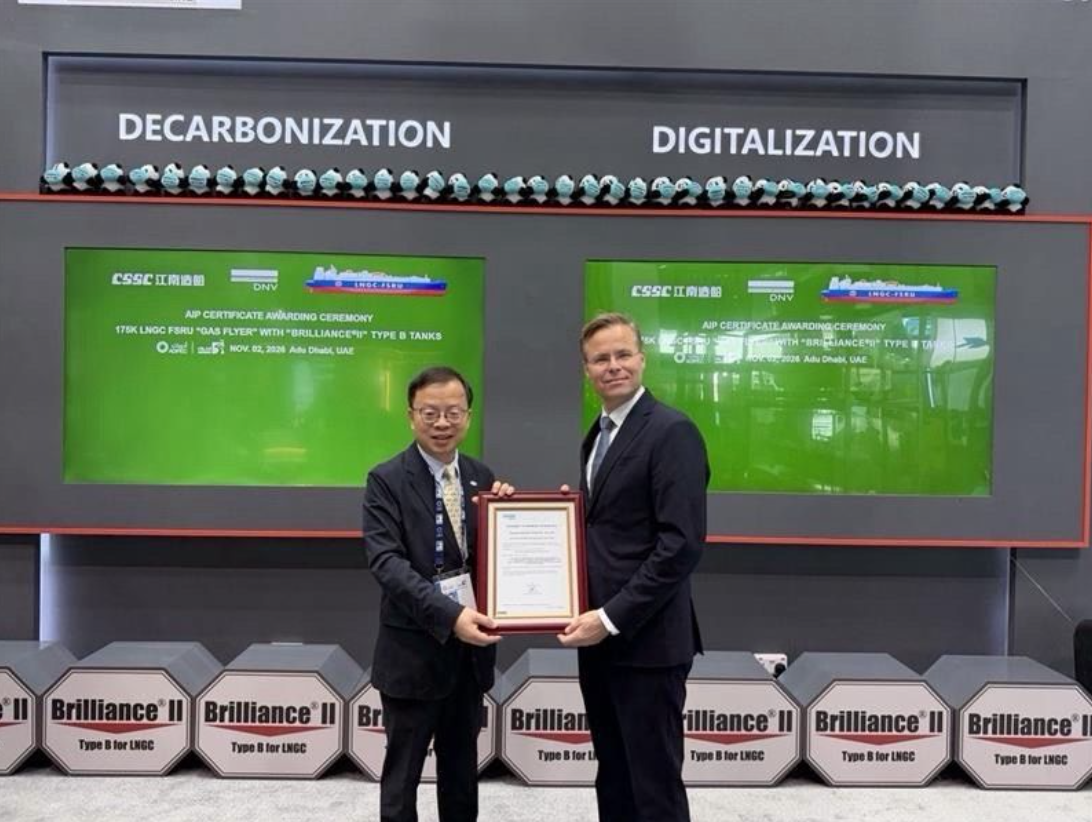
The award was presented by Torgeir Sterri, SVP & Director Offshore Classification and DNV Industrial Product Assurance, to Hu Keyi, Chief of Corporate Technology at Jiangnan Shipyard at ADIPEC 2026 in Abu Dhabi recently. The AiP follows DNV’s preliminary review of the design for safety, feasibility and rule compliance, supporting its progression to detailed engineering.
The design is based on the concept of “one hull, dual mission,” combining LNG transportation with terminal regasification capability. It features four Brilliance® II Type B cargo tanks developed by Jiangnan Shipyard, which are not restricted by filling level and can support both long-distance LNG transportation and long-term FSRU operation. The regasification system adopts a “3+1” redundancy design, with a rated send-out capacity of 750 mmscfd, a peak capacity of up to 1,000 mmscfd and a minimum stable send-out of 50 mmscfd.
A hybrid electric propulsion system is also integrated into the design, with provision for fuel cells, shore power and alternative fuels. Jiangnan Shipyard’s JNiS intelligent system and predictive maintenance solution provide condition monitoring and early fault detection for key equipment, including the regasification lines and dual-fuel generators. The design targets up to 10 years without conventional internal cargo tank inspection and up to 20 years without dry-docking, supported by risk-based assessment, online monitoring, underwater inspection and long-life coatings, with the aim of reducing lifecycle OPEX for FSRU operations.
DNV will provide independent technical assurance to support the design as it progresses towards detailed engineering and potential project implementation. An Approval in Principle (AiP) is an independent evaluation of a concept against a defined set of requirements, confirming the feasibility of the design and that there are no significant technical obstacles to its implementation.