


On November 11, Yangzijiang Shipbuilding Group released its Q3 2026 earnings report. As of October 31, 2026, the company had secured 87 new vessel orders with a total value of $6.98 billion—reaching 155% of its annual order target of $4.5 billion—driven by demand for LNG dual-fuel ultra-large container ships and large bulk carriers. Additionally, the company delivered 47 vessels, representing 81% of its annual delivery target of 58 ships.
As of October 31, 2026, Yangzijiang Shipbuilding held an orderbook of 285 vessels, totaling 12.65 million compensated gross tons (CGT) and valued at approximately US$26.3 billion. With delivery schedules extending through 2031, both the number of vessels on order and the total contract value have reached historic highs. The orderbook features a diverse mix of vessel types, comprising 173 container ships, 44 tankers, 43 bulk carriers, and 25 gas carriers. In terms of contract value, vessels powered by clean energy account for approximately 67% of the total orderbook.
The specific data are as follows:
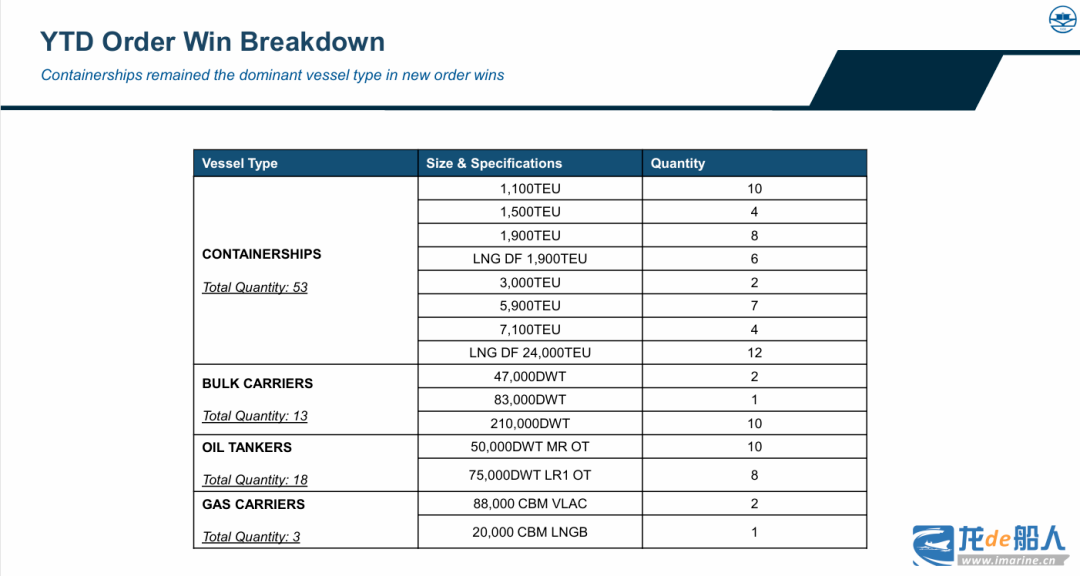
Performance reports indicate that from January to October 2026, Yangzijiang Shipbuilding secured new vessel orders totaling 87 ships, with a combined value of $6.98 billion. These include 53 container ships, 13 bulk carriers, 18 oil tankers, and 3 gas carriers.
The 53 container ships consist of: 10 vessels of 1,100 TEU, 4 vessels of 1,500 TEU, 8 vessels of 1,900 TEU, 6 LNG dual-fuel vessels of 1,900 TEU, 2 vessels of 3,000 TEU, 7 vessels of 5,900 TEU, 4 vessels of 7,100 TEU, and 12 LNG dual-fuel vessels of 24,000 TEU.
The 13 bulk carriers consist of: two 47,000 DWT bulk carriers, one 83,000 DWT bulk carrier, and ten 210,000 DWT bulk carriers. The 18 tankers comprise: ten 50,000 DWT MR-type product tankers and eight 75,000 DWT LR1 product tankers. The 3 gas carriers include: two 88,000 cbm VLACs and one 20,000 cbm LNG bunkering vessel.
Excluding the 38 new shipbuilding orders—valued at $1.75 billion—that had already been disclosed as of the first half of 2026, Yangzijiang Shipbuilding secured an additional 49 orders between July and October, with a total value of $5.23 billion.
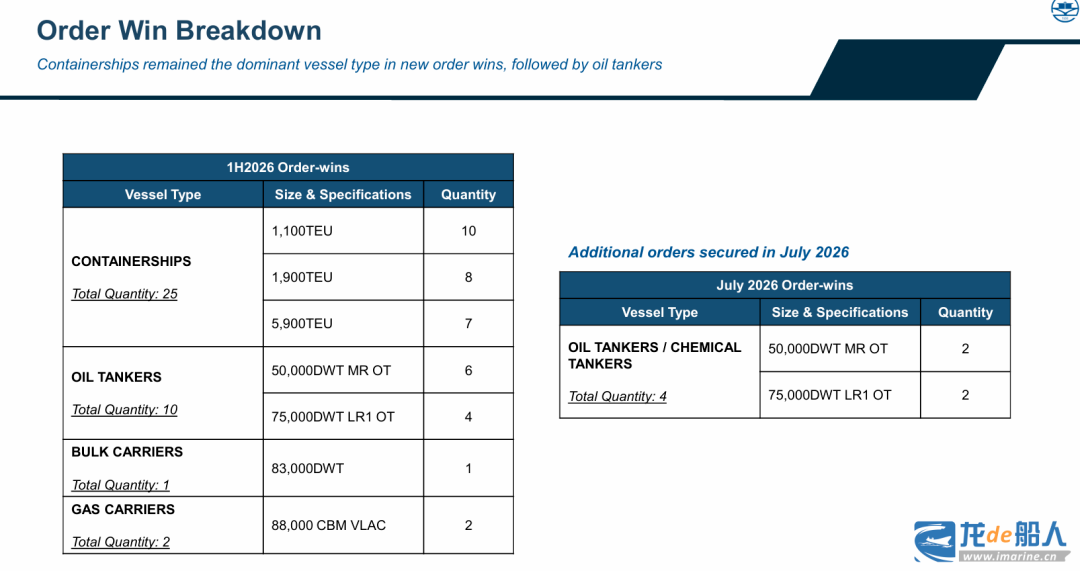
Compared with the order data from the first half of 2026 (as shown in the chart above), new orders placed between July and October include: 4 container ships of 1,500 TEU, 2 of 3,000 TEU, 4 of 7,100 TEU, 6 LNG dual-fuel container ships of 1,900 TEU, and 12 LNG dual-fuel container ships of 24,000 TEU; 4 MR product tankers (50,000 DWT) and 4 LR1 product tankers (75,000 DWT); 2 bulk carriers of 47,000 DWT and 10 bulk carriers of 210,000 DWT; and 1 LNG bunkering vessel with a capacity of 20,000 cubic meters.
According to publicly available information, these new orders include two 3,000 TEU container ships commissioned by Singapore’s Samudera Shipping; a total of ten 210,000 DWT bulk carriers ordered by Seaspan Corporation and South Korea’s HMM; twelve 24,000 TEU LNG dual-fuel container ships reportedly ordered by France’s CMA CGM; and two 75,000 DWT LR1 product tankers commissioned by Belgium’s Transpetrol.
Order backlog: 285 vessels / valued at $26.3 billion
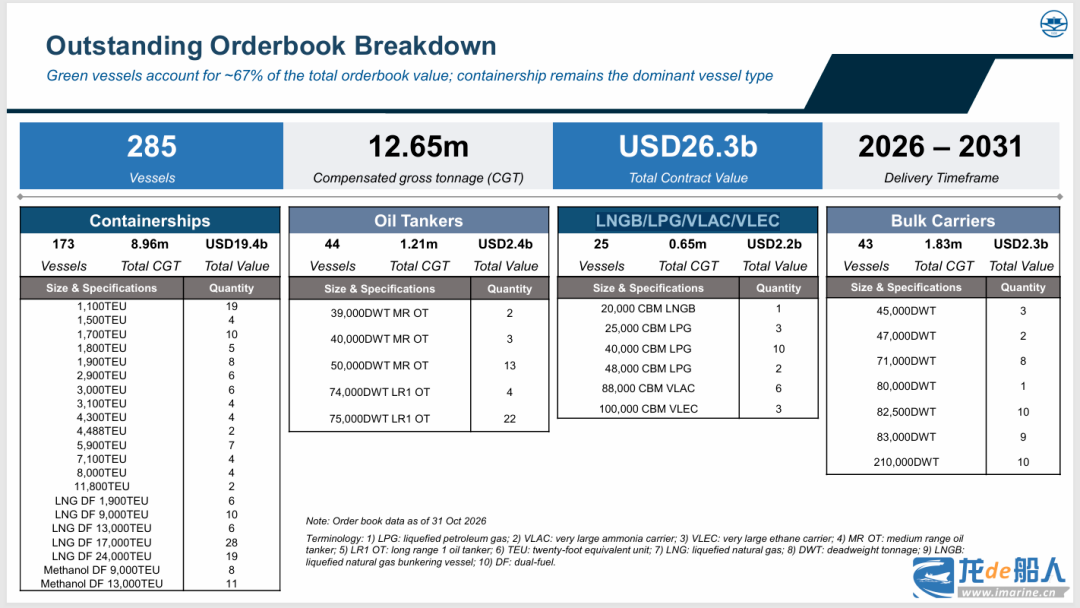
Base on the performance report, as of October 31, 2026, Yangzijiang Shipbuilding held an orderbook of 285 vessels with a total value of $26.3 billion. Delivery schedules span from 2026 to 2031, with container ships accounting for the largest share of the orders. Broken down by vessel type:
Yangzijiang Shipbuilding’s orderbook for container ships comprises 173 vessels, totaling 8.96 million compensated gross tonnage (CGT) and valued at $19.4 billion. This includes: 19 vessels of 1,100 TEU, 4 of 1,500 TEU, 10 of 1,700 TEU, 5 of 1,800 TEU, 8 of 1,900 TEU, 6 of 2,900 TEU, 6 of 3,000 TEU, 4 of 3,100 TEU, 4 of 4,300 TEU, 2 of 4,488 TEU, 7 of 5,900 TEU, 4 of 7,100 TEU, 4 of 8,000 TEU, 2 of 11,800 TEU, 6 LNG dual-fuel vessels of 1,900 TEU, 10 LNG dual-fuel vessels of 9,000 TEU, 6 LNG dual-fuel vessels of 13,000 TEU, 28 LNG dual-fuel vessels of 17,000 TEU, 19 LNG dual-fuel vessels of 24,000 TEU, 8 methanol dual-fuel vessels of 9,000 TEU, and 11 methanol dual-fuel vessels of 13,000 TEU.
The orderbook for oil tankers stands at 44 vessels (1.21 million CGT), valued at $2.4 billion. This includes two 39,000 DWT MR product tankers, three 40,000 DWT MR product tankers, 13 50,000 DWT MR product tankers, four 74,000 DWT LR1 product tankers, and 22 75,000 DWT LR1 product tankers.
The orderbook for gas carriers (including LNG bunkering vessels, LPG carriers, VLACs, and VLECs) comprises 25 vessels (650,000 CGT), valued at $2.2 billion. This includes one 20,000 cbm LNG bunkering vessel, three 25,000 cbm LPG carriers, 10 40,000 cbm LPG carriers, two 48,000 cbm LPG carriers, six 88,000 cbm VLACs, and three 100,000 cbm VLECs.
The orderbook for bulk carriers consists of 43 vessels (1.83 million CGT), valued at $2.3 billion. This includes three 45,000 DWT bulk carriers, two 47,000 DWT bulk carriers, eight 71,000 DWT bulk carriers, one 80,000 DWT bulk carrier, 10 82,500 DWT bulk carriers, nine 83,000 DWT bulk carriers, and 10 210,000 DWT bulk carriers.
47 vessels delivered from January to October
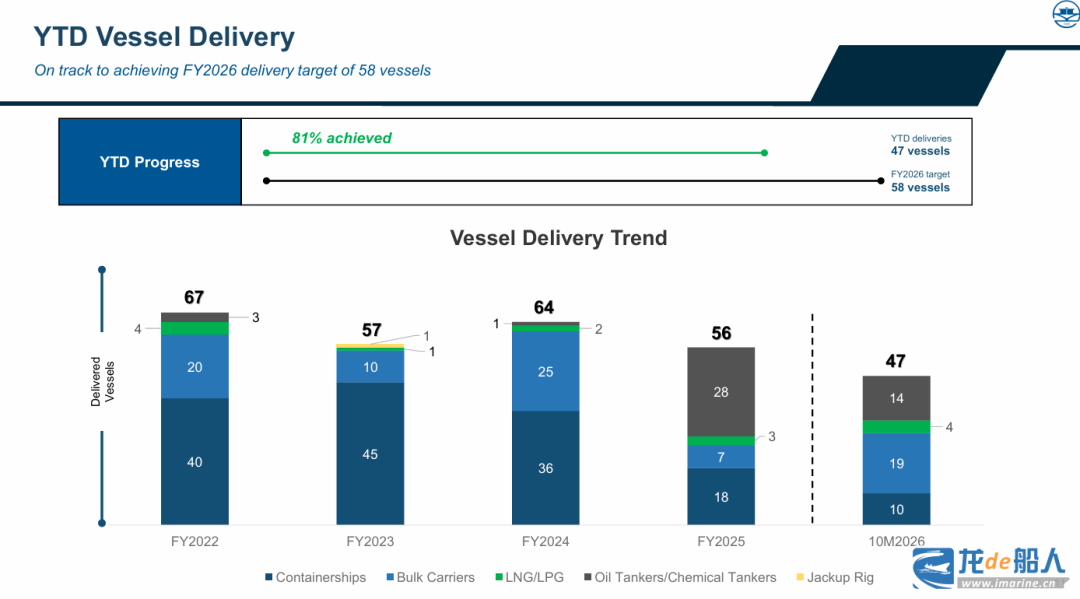
During the reporting period, Yangzijiang Shipbuilding delivered a total of 47 vessels, comprising 10 containerships, 19 bulk carriers, 4 gas carriers, and 14 oil tankers. For 2026, the company plans to deliver 58 vessels in total, with approximately 81% of these deliveries scheduled between January and October.
In its shipping business segment, during the first three quarters of 2026, Yangzijiang Shipbuilding sold 9 vessels (four 92,500 DWT bulk carriers, four 52,000 DWT bulk carriers, and one 1,800 TEU container ship). Concurrently, the company added to its fleet one 82,000 DWT bulk carrier, two self-constructed 50,000 DWT MR-type product tankers, and one self-constructed 175,000-cubic-meter LNG carrier.
As of the end of the third quarter of 2026, Yangzijiang Shipbuilding operated a fleet of 28 vessels with an average age of 8.5 years and a total capacity of 1,762,300 deadweight tonnes (DWT) / 175,000 cubic meters (cbm). The fleet comprised 22 bulk carriers, 2 stainless-steel chemical tankers, 2 MR-class product tankers, 1 LNG carrier, and 1 multipurpose vessel.
Commenting on the operational performance and market outlook, Mr. Ren Letian said:“We have made strong progress in securing new orders this year. As at 31 October 2026, the Group has secured 87 vessels worth US$6.98 billion, surpassing our full-year order win target of US$4.5 billion by 55%. This was underpinned by contracts for ultra-large LNG dual-fuel containerships and large bulk carriers. Newbuild demand remains firm, supported by fleet renewal, the transition towards dual-fuel vessels and ongoing trade route disruptions that continue to absorb shipping capacity. With delivery slots across the industry largely committed through 2029, we remain selective, prioritising vessel types and contract terms that preserve the quality of our orderbook. Looking ahead, our focus is on executing our orderbook with quality, ramping up our Hongyuan yard to support growth in the coming years, and progressively filling our remaining 2030 delivery slots, while delivering sustainable returns to shareholders.”