


Recently, Indian shipbuilder Swan Defence and Heavy Industries (SDHI) released its unaudited financial results for the first half of the 2027 fiscal year (ending September 30, 2026). During this period, SDHI recorded an operating revenue of 994 million Indian rupees (approximately US$10.47 million)—a 2.5-fold increase compared to the 399 million rupees reported in the same period the previous year. The company also posted a net profit of 5.2478 billion rupees (approximately US$55.26 million), a dramatic turnaround from a net loss of 152 million rupees in the prior-year period, marking a return to profitability.
As of September 30, 2026, SDHI’s confirmed order book stood at approximately 65 billion Indian rupees (about US$684 million), with delivery schedules extending through 2031. Additionally, the company sold five “unfinished” platform supply vessels (PSVs) to the offshore vessel owner San Maritime India; the buyer acquired the vessels on an “as-is” basis and has entered into a contract with SDHI to complete their construction.
The confirmed order portfolio includes: six (plus an option for six more) 18,000 DWT IMO Type II chemical tankers for Norway’s Rederiet Stenersen—reportedly the largest single shipbuilding contract ever secured by an Indian shipyard, and the first order for new-build chemical tankers in India; four 92,500 DWT ammonia dual-fuel bulk carriers for Energy ONE—the first order for ammonia dual-fuel vessels placed with an Indian shipyard; four “TRAnsverse 3200” harbor tugs for Svitzer; and one training vessel for the Royal Navy of Oman.
In addition to newbuild projects, SDHI completed seven ship repair and conversion projects during the first half of fiscal year 2027, involving vessels ranging from Indian Coast Guard ships and merchant vessels to offshore drilling rigs. SDHI has also entered into a strategic partnership with the major international classification society DNV—a first for any Indian shipyard. The scope of this collaboration spans seven key areas: design certification, repair projects, research and development, the supplier ecosystem, next-generation maritime technologies, digital implementation, and cybersecurity.
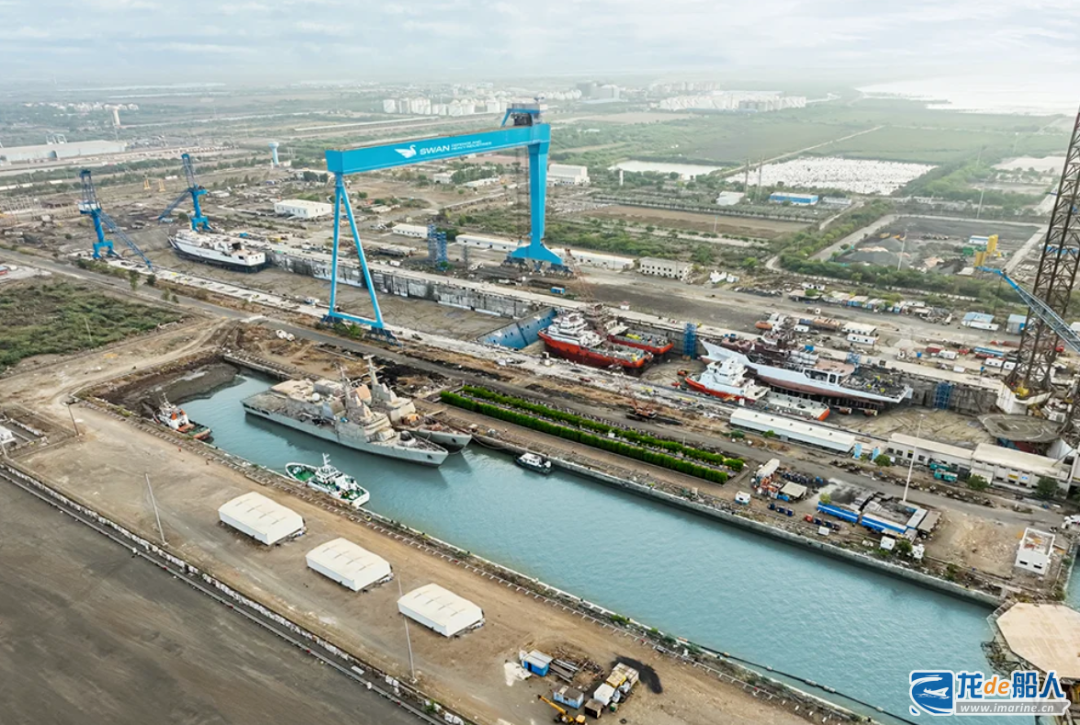
Regarding production capacity, SDHI’s expansion project—part of its “Shipbuilding Development Scheme (SbDS)”—has received in-principle approval from Indian authorities. The project includes the procurement of a 600-ton gantry crane and a 40-ton level-luffing (ELL) crane, aimed at enhancing the operational capabilities and production efficiency of India’s largest dry dock.
In their assessment of the financial results, SDHI’s senior management stated: “In the first half of fiscal year 2027, we transitioned from the debt restructuring phase to a phase of large-scale execution. Having completed our restructuring plan and settled obligations to the creditors’ committee, our current focus is on building the systems, processes, and teams necessary to ensure the delivery of orders. Over the next 12 to 18 months, driven by the Indian government’s initiatives to expand the commercial shipbuilding sector and its plans for defense-related shipbuilding projects, domestic demand for shipbuilding in India is expected to recover. SDHI is well-positioned to pursue opportunities in both domestic and international markets, ultimately generating sustainable returns for our shareholders.”
SDHI, formerly known as Reliance Naval and Engineering Limited (RNEL)—the operator of the Pipavav Shipyard—is a leading Indian shipbuilding and heavy equipment manufacturing enterprise. The facility features India’s largest dry dock (662 meters by 65 meters) and a floating dock (340 meters by 60 meters). Spanning an area of 2 million square meters with a 1.2-kilometer-long coastline, the shipyard is capable of constructing very large crude carriers (VLCCs) and offshore engineering equipment.
SDHI features a dedicated offshore engineering shipyard capable of handling the fabrication, installation, and load-out of heavy engineering modules, such as large-scale platforms and offshore structures. Following a US$250 million renovation and upgrade, the facility is now equipped to construct large commercial vessels; it currently accounts for nearly 30% of India’s total shipbuilding capacity.