


On April 20, the 9,500 CEU methanol-carrying PCTC (pure car and track carrier) “Anji Jisheng,” built by CSSC Jiangnan Shipyard in collaboration with China Shipbuilding Trading Co., Ltd. (CSTC) for Anji Logistics, was named and delivered.
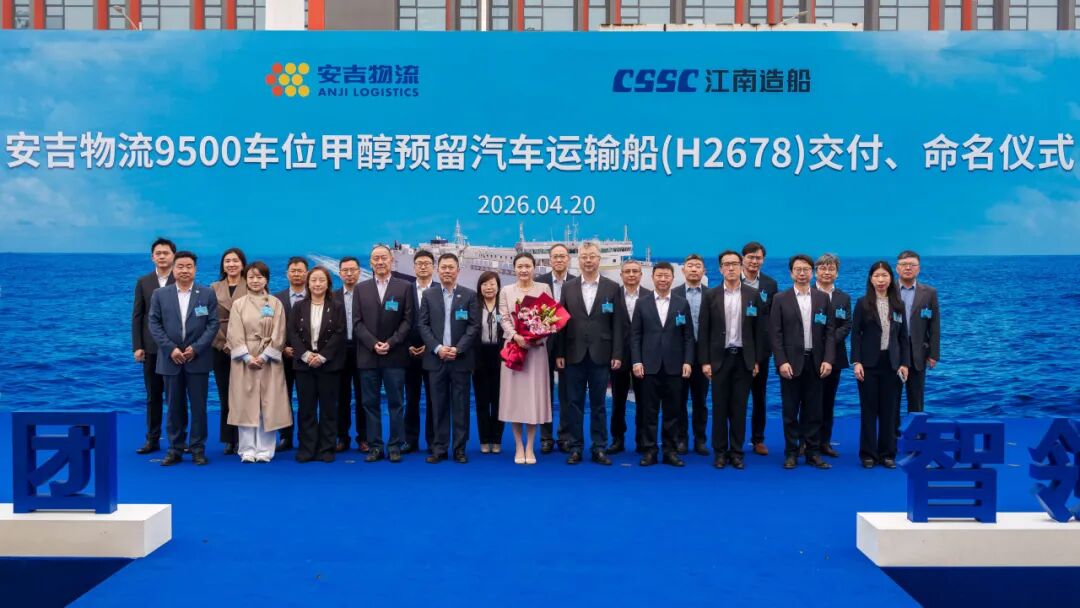
This vessel is the final unit in the 9,500 CEU methanol-ready PCTC series built by Jiangnan Shipyard for Anji Logistics, and it marks Jiangnan Shipyard’s final major project in the PCTC sector for 2026.
This series of 9,500 CEU methanol-ready PCTCs shares a common lineage and design heritage, yet represents a progressive evolution—with each vessel surpassing the last. The lead vessel paved the way and laid the foundation, while the final vessel incorporates the collective experience gained from its two predecessors, emerging as the “pinnacle of performance” in the series.
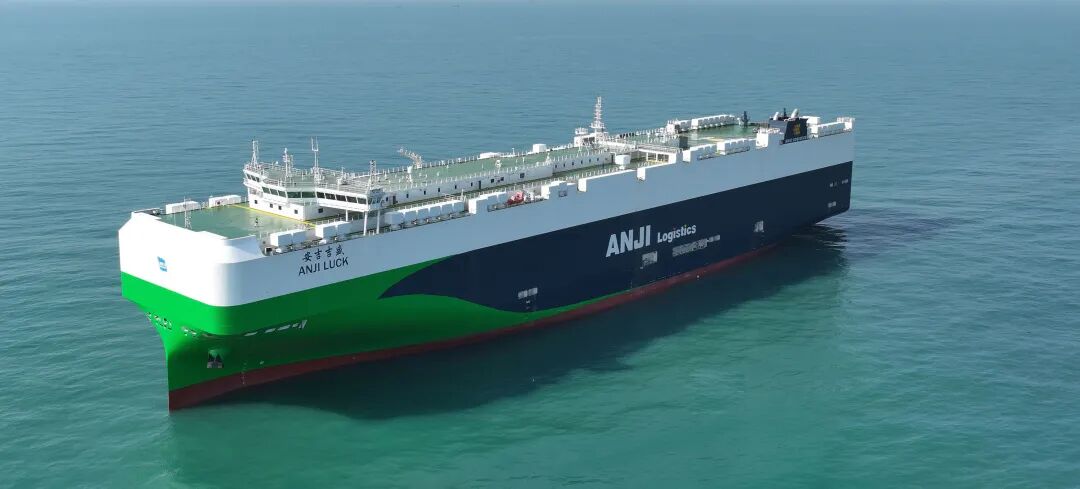
The Anji Jisheng is designed with an overall length of 228 meters, a service speed of 18.54 knots, and is classed by the China Classification Society (CCS). This series of vessels was designed by Shanghai Ship Research and Design Institute (SDARI) and built by Jiangnan Shipyard, possessing fully independent intellectual property rights.
The vessel’s core critical equipment—including the main engine (MAN B&W 7S60ME-C10.5-HPSCR) and associated SCRUBBER system, as well as the Ro-Ro equipment system—was manufactured by subsidiaries of the China State Shipbuilding Corporation (CSSC). With the localization of all core project equipment now realized, Jiangnan continues to uphold the strategic principle of “national ships for national cargo” in the context of China’s overseas automobile transport.
Ranging from the 7,600 CEU and 7,800 CEU classes to the 9,500 CEU methanol-ready PCTC, Jiangnan Shipyard has consistently upheld the principle of “building national ships for national cars, and transporting national cars on national vessels” in China’s deep-sea automotive shipping sector. This series of vessels has fully realized the goal of “national ships with national components”—achieving complete independent control—with core systems such as main engines and Ro-Ro equipment sourced domestically. Boasting a localization rate exceeding 91%, these vessels have decisively broken the monopoly previously held by foreign technologies.