

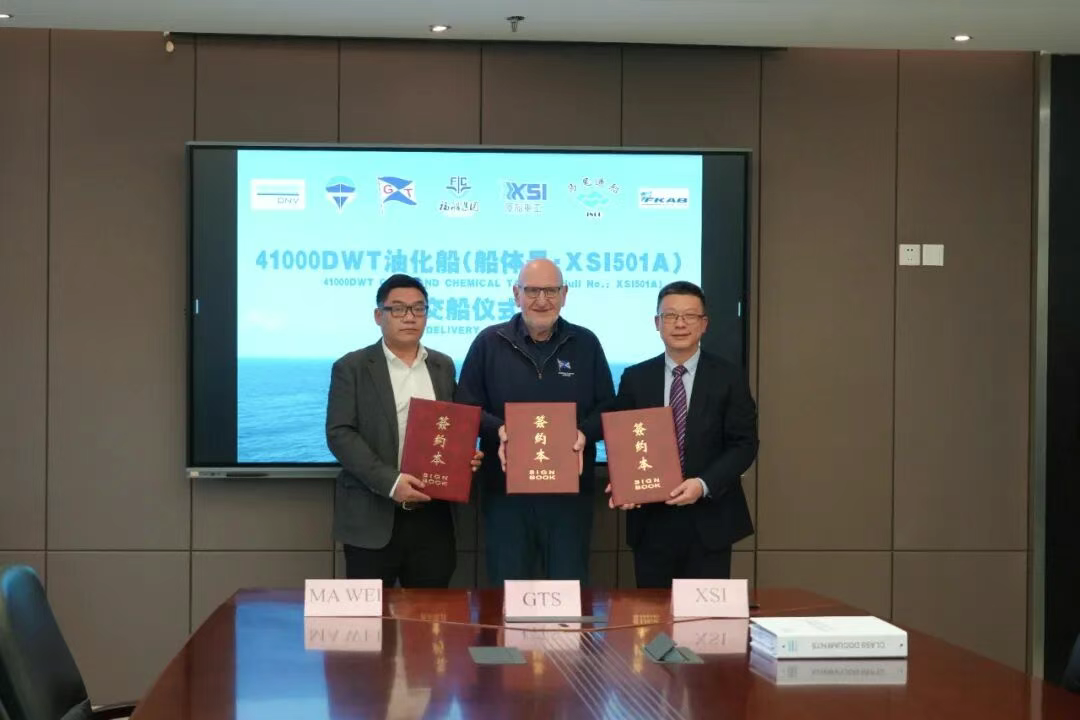
Recently, Xiamen Shipbuilding Industry, a subsidiary of Fujian Shipbuilding Industry Group, successfully delivered the high-end oil and chemical tanker “SEADEVIL” with a deadweight tonnage of 41,000 tons.
As a world-class MR oil tanker, the construction of the SEADEVIL overcame multiple core technological challenges throughout its development. Breakthroughs were achieved in areas such as propulsion systems, extreme environment adaptation, and green intelligent integration. This project not only demonstrates Xiamen Shipbuilding Industry’s formidable capabilities in intelligent manufacturing but also fills several gaps in China’s high-end shipbuilding technologies, propelling the nation’s shipbuilding industry toward high-end transformation.
China’s first vessel equipped with an adjustable propeller overcomes challenges of efficient propulsion in ice-covered waters
One of the core technological breakthroughs of this vessel is that it is the first vessel in China to be equipped with a real-time pitch and speed optimized adjustable propeller system. Its research and development and integration have extremely high requirements for the matching accuracy of hull line, power output and operating conditions, achieving dynamic pitch optimization and improving propulsion efficiency by more than 10%. At the same time, it has overcome the problem of seamless switching between low-speed icebreaking and normal navigation in ice-covered areas.
To adapt to extremely cold environments down to -30°C, the propeller is reinforced according to ice-zone standards, ensuring ice resistance and filling the gap in the domestic MR oil and chemical tankers for navigation in extremely cold ice zones. Equipped with an intelligent power management system, it can adjust propeller pitch and speed in real time and switch between PTO/PTI/PTH modes, achieving an 8% reduction in fuel consumption and obtaining DNV Smart Ship Notation certification.
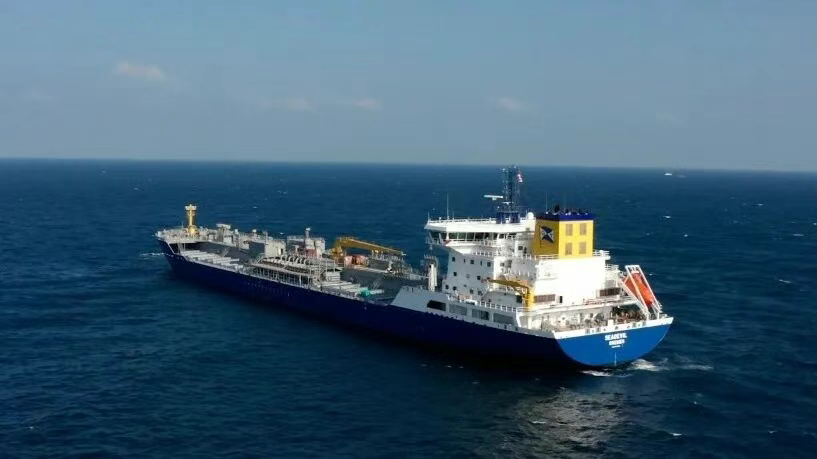
The vessel is tackling green energy challenges and has reserved space for methanol compatibility.
Green power integration is the key focus of this vessel. The vessel adopts a methanol-preserved design and is equipped with a 402kWh lithium titanate battery for emergency power supply. When docked, it can connect to medium-voltage shore power. Combined with shaft-driven power generation and waste heat recovery systems, it meets the latest IMO environmental regulations and its emissions are far below international limits.
The vessel is capable of transporting high-precision liquid cargo systems and is compatible with a wide range of chemicals.
The precision of the design and construction of the liquid cargo system directly affects navigation safety, and the technology is extremely challenging. The vessel adopts a double bottom and double hull design with epoxy-coated cargo tanks, and has 12 independent cargo oil tanks and 2 sludge oil tanks. Each tank is equipped with an independent pump set and monitoring and control system, which can simultaneously carry 14 kinds of chemicals. It can complete the loading and unloading of multiple categories in a single day, and its loading flexibility reaches the international top level, complying with OCIMF and IBC standards.